
US Bus Trips books this multi-day Arches group tour for families, alumni groups, corporate teams, wedding parties, and small hiking groups that want one vehicle and a controlled itinerary.
Overview
A 14-Passenger Sprinter is a practical match for a small Arches group tour arriving through Moab Canyonlands Regional Airport, Salt Lake City, Grand Junction, or a regional hotel block. Typical customers include family groups, corporate retreats, university departments, photography clubs, and wedding parties that want the same driver for airport pickup, lodging transfers, and park days. The vehicle can cover US 191 between Moab and the Arches entrance, then continue the park road without splitting the party. It is not a substitute for a full motor coach when the group has heavy luggage, multiple equipment cases, or more passengers than the legal seating configuration. Confirm the actual unit because a Mercedes Sprinter and Ford Transit may differ in legroom, storage, and amenities. A good booking file lists passengers, bags, mobility needs, and every planned stop before dispatch assigns the vehicle.
Plan the multi-day schedule around Moab as the operating base rather than changing hotels every night. Most groups stage near Main Street, North Main Street, or the US 191 hotel corridor, where restaurants, grocery stops, and tour operators are easier to reach than remote lodging. Day trips can combine Arches with a controlled evening return to Moab, while Canyonlands Island in the Sky, Dead Horse Point, or a Colorado River activity can fill a separate day without forcing an unrealistic park loop. In spring and fall, weekends and school-break periods tighten hotel inventory and raise vehicle demand across the Moab market. The group should reserve lodging with a legal pull-through or loading area because curb space at busy properties can be limited. A dispatch-ready itinerary includes meal windows, restroom stops, trail difficulty, and a backup for heat, wind, or storm conditions.
Inside Arches, the scenic road is roughly eighteen miles, but distance does not equal easy circulation when parking lots fill. The National Park Service reports no shuttle bus system, so a commercial group must bring its own transportation and manage its own passenger movements. A current Commercial Use Authorization and applicable conditions must be carried and available at the entrance station for commercial operations. Parking is restricted to established areas, and larger vehicles must use legal bus or oversized spaces where provided; Windows and Double Arch, Delicate Arch viewpoints, and Wolfe Ranch require particular attention to loading and parking locations. A 14-Passenger Sprinter has an advantage over a full motor coach at some approaches, but it is still not permitted to block traffic or create an improvised roadside loading zone. Keep the driver with the vehicle, use short scheduled stops, and have passengers ready before the van enters a loading area.
Fleet Options
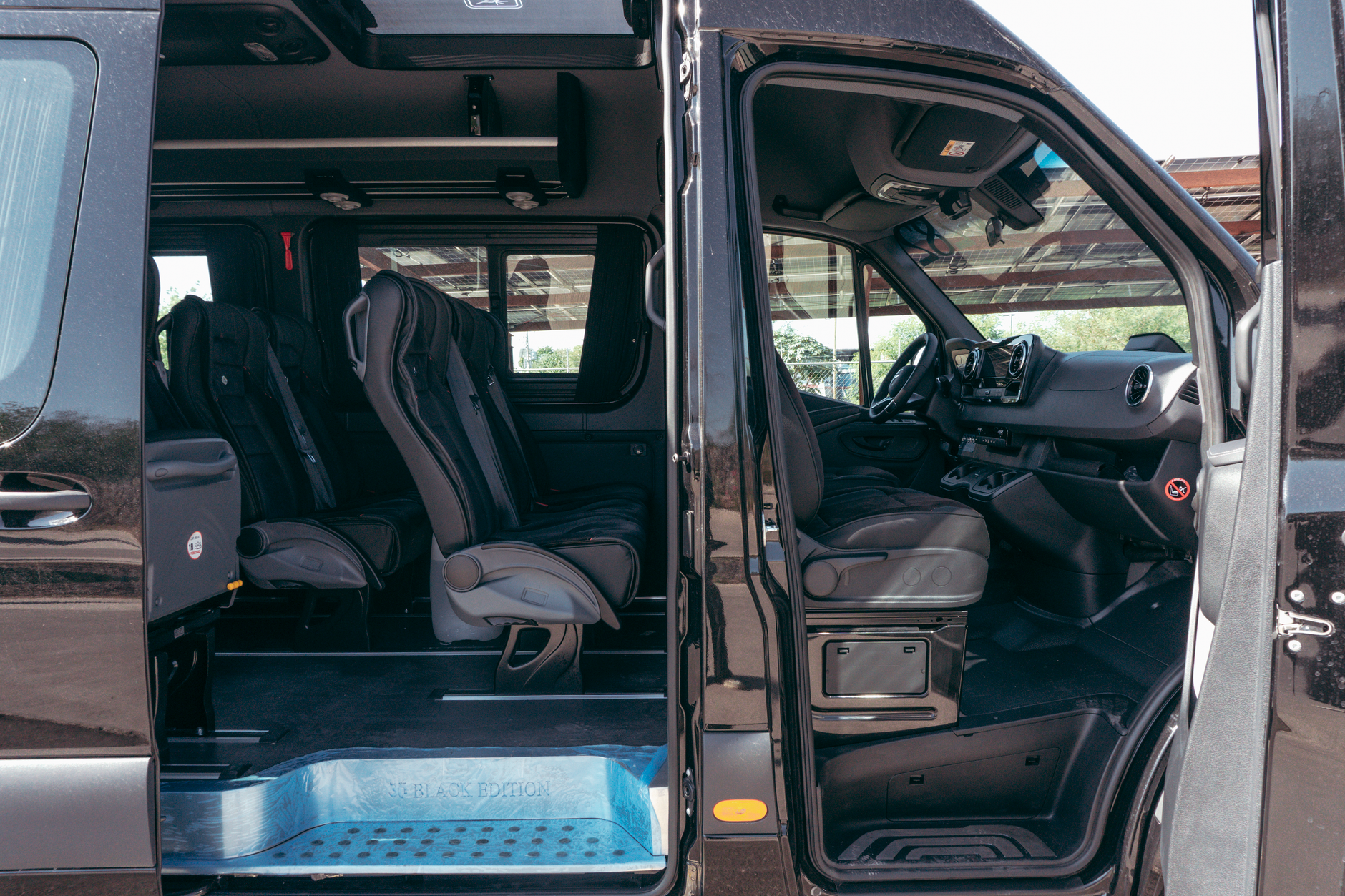
Choose the vehicle against the real passenger count, luggage volume, and road plan, not just the advertised seat total. A 14-Passenger Sprinter suits a group tour of up to fourteen passengers when the party carries soft bags, daypacks, and limited equipment. Executive Mercedes Sprinter and Ford Transit units may offer leather captain's chairs, WiFi, USB charging, and a quieter cabin, but small cargo bays become tight at full capacity. The van is easier to position at Moab hotels and limited oversized parking areas than a full motor coach, although it still needs legal spaces and cannot stop in travel lanes. If the itinerary includes bulky luggage, multiple coolers, or a large guide kit, reduce the passenger load or move up to a mini coach or motor coach.
| Vehicle | Seats | Best For | Notes |
|---|---|---|---|
| Executive Mercedes Sprinter | Up to 14 passengers | Use it for a compact Arches group tour with light luggage, airport transfers, and hotel-to-trailhead movements. | Best for VIP transfers and small tour groups needing leather captain's chairs, WiFi, USB charging, and a polished cabin; cargo remains limited with every seat occupied. |
| Ford Transit passenger van | Up to 14 passengers | Use it when dependable capacity and value matter more than executive trim and the group carries modest soft luggage. | A practical 14-passenger configuration can handle straightforward corridor travel and smaller parking approaches, but confirm the exact seat layout, luggage bay, and onboard amenities before contracting. |
| Mini coach | Approximately 18- thirty passengers | Use it when the group exceeds fourteen, needs more luggage space, or wants wider seating without committing to a large coach. | Provides more interior room and often better luggage capacity than a Sprinter while remaining easier to place than a full motor coach; verify height, length, and local parking access. |
| Motor coach | Approximately thirty-five to fifty-six passengers | Use it for a larger multi-day group, substantial luggage, or a route where keeping everyone in one vehicle outweighs tight-site convenience. | Offers the greatest passenger and luggage capacity and may include an underfloor bay and restroom, but larger dimensions make Arches parking, hotel approaches, and trailhead circulation more restrictive. |
Routing, Timing, and On-the-Road Realities
For a Salt Lake City origin, the common approach uses I-15 and I-70 toward US 191, with Green River or Price serving as useful break and driver-control points depending on the roster. Denver-origin groups generally use I-70 west through the Colorado high country and should not promise a same-day sightseeing program after a long morning departure. Grand Junction offers a shorter western Colorado approach, while Las Vegas and Phoenix require a much longer multi-day plan with an overnight positioned before Moab. Pickups should leave enough margin for urban traffic, mountain weather, construction, meal stops, and the entrance approach rather than targeting the exact park opening minute. In Moab, schedule hotel loading before the street becomes busy and use a prearranged meeting point instead of asking passengers to scatter along Main Street. A motor coach may need a separate hotel approach check, while a 14-Passenger Sprinter usually has more flexibility but still needs safe curb access.
Use an early departure for the first Arches day, especially for The Windows, Double Arch, Delicate Arch viewpoints, and Devils Garden, where limited parking can disrupt a tightly timed loop. The park's commercial conditions permit loading only in designated zones and limit bus unloading or pickup to short periods, commonly no more than fifteen minutes. Wolfe Ranch uses oversize parking opposite the main lot, and Windows or Double Arch should be handled from the bus parking area rather than an improvised shoulder stop. Keep the itinerary flexible because the National Park Service can divert vehicles when entrances or destinations become congested, and visitors are asked not to wait in roadways for spaces. Driver duty time includes the approach, park navigation, waiting, passenger loading, and return to the hotel, so a second driver or an overnight split may be necessary on long corridors. Build a recovery block each day instead of stacking timed hikes, dinner reservations, and a late return on the same shift.
What This Typically Costs
A multi-day Arches group tour in a 14-Passenger Sprinter is usually priced from a per-day vehicle and driver rate, with a daily minimum even when the van is parked. The quote also reflects total mileage, including deadhead from the vehicle's home market to the pickup and the return leg after the final drop-off. Peak spring and fall dates, weekends, holidays, and major Moab event periods commonly carry higher rates because vehicle supply and driver lodging tighten. Driver overnight lodging, meals or per diem, parking, park entry or commercial-use costs, and any required permits are typically separate line items or clearly identified allowances. Fuel may be included, capped, or adjusted when fuel prices move materially, so the confirmation should state the policy. Budget separately for driver gratuity, passenger meals, hotels, trail reservations, and optional guides rather than assuming they are included. In most markets, a professionally operated multi-day run commonly reaches a few thousand dollars per day before long deadhead, premium lodging, or added mileage, but an exact quote requires dates and the complete route.
Frequently Asked Questions
How many people and bags fit in a 14-Passenger Sprinter?
A 14-Passenger Sprinter can be an excellent fit for a small Arches group tour when the headcount is truly fourteen passengers or fewer and luggage is light. Executive Mercedes Sprinter and Ford Transit configurations commonly provide leather captain's chairs, WiFi, USB charging, and small cargo capacity. Count every passenger, guide, and child seat before booking because a full passenger load can leave limited room for coolers, hiking packs, and overnight bags. For checked-size luggage or bulky outdoor equipment, a trailer, luggage support vehicle, or larger motor coach may be safer than filling every seat.
How many days should a group tour to Arches take?
The practical trip length is usually three to five days from a regional origin, with the first day reserved for the long approach and the middle days used for Arches and nearby Moab stops. A group starting in Salt Lake City can often use the first day for US 6 and I-70 travel, while a Denver-origin group needs more road time and should avoid treating the drive as a casual afternoon transfer. Two full in-park days allow a more reliable pace for Windows, Delicate Arch viewpoints, Balanced Rock, and Devils Garden. A one-night turn is possible from nearby markets but leaves little recovery time for weather, congestion, or driver-hour limits.
What are the best months for an Arches group tour?
April through May and September through October are generally the most workable months for a multi-day Arches itinerary because daytime conditions are more manageable than midsummer and winter access is less predictable. Spring break, Easter periods, fall weekends, and holiday dates can still produce entrance lines and scarce parking. June through August brings heat exposure on open slickrock, early sunrise planning, and higher demand for Moab lodging, although early starts can make the schedule workable. November through February can offer lighter visitation but requires flexibility for cold, snow, wind, and shorter daylight. Check current park conditions before departure rather than relying on a seasonal average.
Does a 14-Passenger Sprinter need a permit at Arches?
A commercial operator taking a paid group into Arches generally needs a current signed Commercial Use Authorization, or CUA, available for inspection at the entrance station. The authorization and applicable activity conditions govern where the vehicle may stop, how the group is managed, and what commercial fees apply. The National Park Service states that there is no park shuttle system, so the Sprinter must provide its own transportation. Advanced timed-entry reservations are not required for the 2026 season, but entrance congestion and limited parking remain operational concerns. Fiery Furnace hikes and Devils Garden Campground have separate reservation requirements.
Where can a Sprinter park and unload inside Arches?
The Sprinter should use only established parking areas and legal bus or oversized spaces when those spaces are designated for larger vehicles. At Windows and Double Arch, drop-off and pickup should occur in the bus parking area, and Wolfe Ranch uses oversize parking on the south side of the road rather than the main lot. Commercial conditions limit loading and unloading to signed zones and generally allow no more than fifteen minutes, with no blocking of through traffic. The driver should not circle indefinitely waiting for a space or stop on the roadway for photographs. A smaller vehicle is easier to position than a full-size motor coach, but it still must follow posted routing and parking controls.
How do driver hours affect a multi-day Arches itinerary?
Driver scheduling must account for federal hours-of-service requirements, the actual duty day, and the return or repositioning plan rather than just windshield time. A long first-day corridor run from Denver, Salt Lake City, Las Vegas, or another state can consume most of a driver's available work window before the group reaches Moab. The safest plan uses a qualified relief driver, a planned overnight, or a shorter first-day segment when the route cannot be completed legally and comfortably in one shift. Park sightseeing also counts as a demanding workday when the driver handles loading, navigation, waiting, and repeated trailhead movements. The final itinerary should show driver start, stop, break, and overnight points.
When should we choose a motor coach instead of a Sprinter?
A 14-Passenger Sprinter works well for executive transfers, family reunions, university groups, wedding parties, and small hiking or photography groups that value direct routing and a quiet cabin. It is especially useful when the itinerary includes hotel transfers, airport pickup, and short local movements around Moab rather than a large amount of gear. A motor coach is more appropriate when the party has substantial luggage, needs onboard restroom access, or wants one vehicle for a much larger group. A mini coach may be the middle option when comfort and cargo space matter more than tight parking. Ask whether the operator can provide the requested Mercedes Sprinter or Ford Transit configuration, because seating, luggage room, and amenities vary by unit.
How to Book
To book, send the travel dates, pickup address, final headcount, luggage estimate, overnight cities, and a working itinerary that identifies Arches days and any Moab activities. Include whether the group needs an executive Mercedes Sprinter or Ford Transit, airport service, a guide, child seats, or space for coolers and hiking equipment. US Bus Trips can typically return an initial quote within 4 business hours when the route and dates are complete, subject to vehicle and driver availability. The confirmation should identify the vehicle class, passenger capacity, pickup instructions, operating hours, mileage or deadhead assumptions, driver lodging, permits or park fees, cancellation terms, and payment schedule. Reach us with the itinerary and a dispatcher can test the route before finalizing the reservation.
Related Trips You Might Also Consider
- Robotics Competition — Pacific Region
- Carlsbad Caverns — 24-Passenger Mini Bus
- Dance Competition — Northeast Region
- Agriculture FFA/4-H — Mountain West Region
- Redwoods — 14-Passenger Sprinter
- Grand Canyon — 14-Passenger Sprinter
- Cross-Country Charter Bus Overview
- All Group Trip Types
- See the Full Fleet (Sprinters through 56-pax coaches)
- Get a Free Quote in 60 Seconds