
Trade associations book US Bus Trips for annual meeting shuttles, board offsites, airport transfers, and host-city city tours across the Southeast.
Overview
An Association Conference in the Southeast often combines several transportation jobs under one master itinerary. A trade association may need airport transfers into Atlanta, Charlotte, Orlando, Nashville, Raleigh, Birmingham, or Savannah, followed by repeated hotel-to-venue shuttles and evening dinner service. Larger programs commonly use venues such as the Georgia World Congress Center, Charlotte Convention Center, Orange County Convention Center, Music City Center, Savannah International Trade and Convention Center, or Birmingham Jefferson Convention Complex. The customer is usually an association executive, meeting planner, destination management company, or exhibit contractor managing attendees from multiple states. The practical requirement is dependable movement between room blocks and meeting space, with clear staging instructions for drivers and a backup plan for late flights or extended sessions.
Southeast group travel is shaped by distance between metros and by freight and commuter congestion on the same highways used by charter buses. I-85 ties Montgomery, Atlanta, Greenville-Spartanburg, Charlotte, Greensboro, and the Research Triangle together, while I-75 carries traffic through Knoxville, Chattanooga, Atlanta, Macon, and Florida. I-95 supports coastal movements through the Carolinas, Savannah, Jacksonville, and South Florida, with local congestion around major metro approaches. Common programs run Atlanta to Charlotte, Charlotte to Charleston or Savannah, Atlanta to Nashville, Nashville to Birmingham, and Orlando to Tampa or Jacksonville. A city tour may add Uptown Charlotte, downtown Atlanta, Nashville's Music Row, Charleston's historic district, Savannah's riverfront, or Orlando's convention and resort corridor, but each stop must be checked for coach access and legal loading space.
Group size varies from a 10-person board to several hundred attendees, exhibitors, speakers, and staff. A charter bus plan for 50 people is different from a 300-person conference because peak arrival and departure waves may require multiple vehicles even when the daily total looks manageable. Cargo can include checked bags, exhibit crates, banners, instruments, uniforms, product samples, golf or beach gear, and mobility devices. College-football weekends increase demand around Athens, Clemson, Chapel Hill, Knoxville, Nashville, Lexington, Tuscaloosa, Auburn, Gainesville, Tallahassee, and Charlotte, while spring break and summer increase pressure on Florida and Atlantic beach markets. An experienced dispatcher builds the schedule around venue curb windows, hotel loading zones, driver relief, and realistic boarding time instead of assuming every bus can load at once.
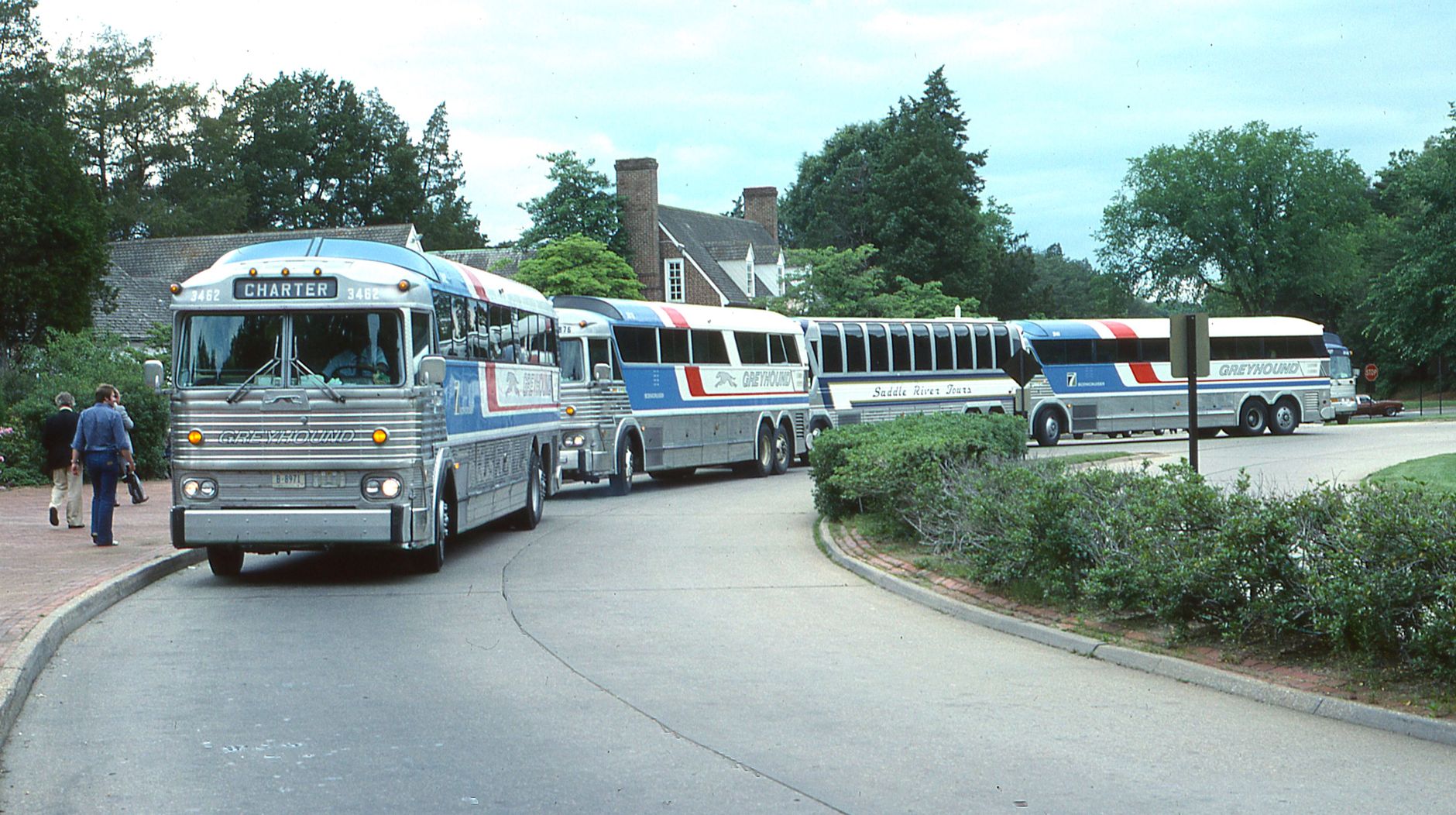
Fleet Options
Vehicle selection for Southeast group travel starts with the headcount, then accounts for luggage, exhibit materials, instruments, uniforms, wheelchairs, and the number of daily departures. A full-size motor coach is efficient for hotel-to-convention-center shuttles and long I-75, I-85, or I-95 legs, while a mini coach fits smaller board groups and tighter downtown stops. Executive Sprinters work well for airport runs, leadership dinners, and short city-tour movements but have limited cargo capacity. Tight hotel drives, historic districts, beach streets, and convention-center curb rules can make a smaller charter bus easier to stage, even when a larger vehicle has enough seats.
| Vehicle | Seats | Best For | Notes |
|---|---|---|---|
| Full-size motor coach | 40-56 passengers | Use for the main Association Conference shuttle, intercity movement, or a large airport transfer with substantial baggage. | Best for luggage, exhibit cases, uniforms, and long highway legs; confirm restroom, wheelchair access, and underfloor storage before assignment. |
| Mini coach | 24-35 passengers | Use when the group is mid-sized or the itinerary includes tighter streets, limited curb space, or several local stops. | Offers coach-style seating with less cargo and a smaller turning radius, making it useful around downtown hotels, campuses, and coastal districts. |
| Mini bus | 18-24 passengers | Use for a compact committee, breakout group, dinner shuttle, or overflow vehicle operating inside one metro. | Practical for short hotel loops and board movements, but verify luggage capacity because many models have little or no underfloor bay. |
| Executive Sprinter | 10-14 passengers | Use for board offsites, host dinners, site inspections, and city-tour segments where discretion and easy parking matter. | Comfortable for leadership groups and airport transfers, with limited luggage space and no substitute for a full coach when equipment is involved. |
Routing, Timing, and On-the-Road Realities
Route planning begins with the actual pickup sequence, not a straight-line map estimate. For Atlanta service, I-75 and I-85 converge through the Downtown Connector, and I-285 can add significant delay before a bus reaches a hotel or convention venue. Charlotte programs may involve I-85, I-77, Uptown curb restrictions, and event traffic around Bank of America Stadium or the convention center. Nashville movements should account for I-24, I-40, Music Circle-area streets, and concert or football traffic; Birmingham and Chattanooga can be affected by I-59 and I-24 approaches. Morning hotel departures should usually be staged before the main commuter peak, while airport pickups need flight buffers, baggage time, and a defined meeting point that a large coach can reach.
I-95 coastal runs require planning for beach-season congestion, bridge approaches, and limited hotel loading space in Charleston, Myrtle Beach, Savannah, Jacksonville, and Daytona Beach. Orlando convention transfers are often short by mileage but slow around the Orange County Convention Center, International Drive, airport approaches, and resort entrances. Long-haul group travel on I-75 or I-85 should include fuel, meal, restroom, and driver-hour assumptions, with an overnight stop when the legal schedule cannot support a same-day return. For multi-vehicle service, assign a lead bus, stagger departures, give each driver a manifest and venue map, and reserve separate staging positions where possible. Downtown convention centers may have narrow curb windows, while campuses and stadium districts can impose event-day police direction, so the final run sheet should be confirmed with the venue and hotel before dispatch.
What This Typically Costs
Association Conference transportation in the Southeast is usually priced from a daily minimum, then adjusted for route miles, service hours, vehicle count, and deadhead positioning. A local hotel shuttle may carry a one-day or multi-day minimum, while an Atlanta to Charlotte, Nashville to Birmingham, or Raleigh to Orlando movement is quoted around total mileage and driver-hours. Seasonal peaks around college football weekends, spring break, beach travel, and major conventions can reduce availability and raise operating costs. Long runs may require driver overnight lodging, parking, tolls, and repositioning miles before or after the passenger itinerary. Common line items include fuel adjustments, parking, permits where required, and a customary driver gratuity handled separately from the transportation charge. In most markets, a charter bus or motor coach commonly runs a few thousand dollars per day, but the confirmed range depends on dates, vehicle class, mileage, and whether the bus must deadhead between Southeast markets.
Frequently Asked Questions
What size charter bus fits an association conference group?
A 40 to 56 passenger motor coach is the normal starting point for an Association Conference shuttle or board offsite. It provides underfloor luggage space, reclining seats, climate control, and a restroom on many full-size coaches. Smaller groups may use a 24 to 35 passenger mini coach or a 10 to 14 passenger executive Sprinter when parking and hotel access matter more than cargo capacity. The final vehicle should be matched to both passenger count and luggage, not seats alone.
What services are typical for an Association Conference in the Southeast?
The Southeast has two different operating patterns: scheduled hotel-to-venue loops and longer intercity group travel. Annual meetings commonly use repeated morning and evening shuttles between room blocks and venues such as the Georgia World Congress Center in Atlanta, Charlotte Convention Center, Music City Center in Nashville, Orange County Convention Center in Orlando, and Birmingham Jefferson Convention Complex. Board offsites often add airport transfers, dinners, plant visits, and a half-day city tour. A charter bus schedule should identify every stop, dwell time, and return window before vehicles are assigned.
Which Southeast routes are common for association group travel?
The principal corridors are I-95 along the Carolinas and Florida coast, I-85 through Montgomery, Atlanta, Greenville, Charlotte, Greensboro, and the Triangle, and I-75 through Knoxville, Chattanooga, Atlanta, Macon, and Florida. Common city pairs include Raleigh or Charlotte to Atlanta, Atlanta to Nashville, Atlanta to Birmingham, Charlotte to Charleston or Savannah, and Orlando to Tampa, Jacksonville, or South Florida. These routes cross large metro areas where a short final leg can consume substantial time. Dispatch planning should treat Atlanta, Charlotte, Orlando, Nashville, and Miami-area approaches as separate traffic problems rather than estimating only highway distance.
When are charter buses hardest to secure in the Southeast?
College-football weekends create sharp demand around Atlanta, Athens, Clemson, Columbia, Chapel Hill, Charlotte, Knoxville, Nashville, Lexington, Tuscaloosa, Auburn, Gainesville, Tallahassee, and Baton Rouge-adjacent travel even when the meeting is elsewhere. Beach volume rises from late spring through summer around Charleston, Myrtle Beach, Savannah, Jacksonville, Daytona Beach, Orlando, Tampa, and the Florida Keys. Spring break and holiday weekends can tighten the supply of charter bus operators in Florida and coastal South Carolina. Reserve early when an Association Conference overlaps a home game, race weekend, festival, or major convention.
Can the bus carry instruments, uniforms, exhibit gear, or wheelchairs?
Yes, but cargo must be declared before quoting. Instruments, uniforms, exhibit cases, product samples, staging gear, and mobility equipment can consume luggage-bay space that a passenger count does not reveal. A full-size motor coach usually handles standard conference luggage and equipment better than a mini coach, while a trailer or dedicated cargo vehicle may be needed for bulky cases. Wheelchairs should be identified by quantity, dimensions, and whether passengers remain seated during travel so an accessible vehicle can be assigned.
How are multi-vehicle conference shuttles coordinated?
For large groups, dispatch normally divides the roster by hotel, flight bank, venue entrance, and departure time rather than putting every passenger on one vehicle. A 200-person program might use four motor coaches for peak transfers, smaller charter buses for executive movements, and a dedicated accessible vehicle. Each unit needs a numbered manifest, radio or phone contact, staging position, and a lead coordinator. Venue curb space, loading windows, and driver relief must be confirmed because multiple buses cannot always load simultaneously at downtown convention centers.
What information is needed for a Southeast conference transportation quote?
Provide the meeting dates, passenger count, pickup addresses, hotel list, venue, flight details, luggage or equipment description, accessibility needs, and the full schedule of shuttles, dinners, tours, and intercity legs. Include whether the group needs continuous standby service, one-way transfers, or separate airport and convention routes. A city tour can use a motor coach, mini coach, or Sprinter depending on street width, parking, and the number of stops. Once the itinerary is stable, the operator can confirm equipment, driver-hours, staging, overnight requirements, and a realistic operating range.
How to Book
To start a quote, send the dates, pickup addresses, hotel room blocks, venue names, headcount, flight schedule, equipment list, accessibility needs, and every planned shuttle or tour window. Note whether the service is a continuous standby, a set of scheduled loops, or a one-way intercity movement. US Bus Trips can normally return an initial quote or operating range within 4 business hours when the itinerary is complete. The confirmation should identify vehicle type, passenger capacity, pickup times, routing assumptions, driver-hours, parking or lodging requirements, cancellation terms, and the dispatch contact.
Related Trips You Might Also Consider
- Sacramento, CA to Reno, NV
- Atlanta, GA to Charleston, SC
- Tucson, AZ to El Paso, TX
- Redwoods — 36-Passenger Mini Coach
- Mesa Verde — 24-Passenger Mini Bus
- Milwaukee, WI to Chicago, IL
- Cross-Country Charter Bus Overview
- All Group Tour Destinations
- See the Full Fleet (Sprinters through 56-pax coaches)
- Get a Free Quote in 60 Seconds