
A Death Valley group tour in a 14-Passenger Sprinter fits private parties, executive retreats, family groups, and small organized tours that want one dedicated vehicle.
Overview
A Death Valley group tour is often booked by families, university departments, corporate retreat planners, photographers, alumni groups, and destination-management companies moving travelers between Las Vegas, Los Angeles, Palm Springs, Reno, or Southern California. The most common operating pattern is a pickup at a hotel, airport, campus, or private residence followed by a long approach through Pahrump, Beatty, or California State Route 190. A 14-Passenger Sprinter keeps the party together and avoids splitting a small group into rental cars, but it does not eliminate the need for a formal multi-day schedule. Travelers should provide the actual pickup address, not only the metro area, because vehicle deadhead, hotel access, and driver staging can change the quote. Event weekends, spring-break travel, convention calendars in Las Vegas, and limited Furnace Creek lodging can affect availability well before the park visit.
The first planning decision is whether the group wants a park-focused itinerary or a broader Southwest trip that includes Las Vegas, Red Rock Canyon, the Hoover Dam, Pahrump wineries, or a Southern California origin. For a park-focused run, Furnace Creek is the most useful central base for Badwater Basin, Zabriskie Point, the visitor center, and nearby valley attractions, while Beatty and Pahrump can be better gateway staging points when rooms inside the park are unavailable. The group should expect limited services, weak or inconsistent connectivity in remote areas, long distances between fuel opportunities, and little tolerance for unplanned detours. Commercial road-based tours may face restrictions on unpaved roads and on vehicle length for particular routes, so a requested stop list must be checked against the current park notice and vehicle dimensions. A motor coach can carry more people, but a 14-Passenger Sprinter generally offers better flexibility for a small tour if the itinerary stays on suitable paved roads.
Park access is not the same as unrestricted venue access. Death Valley National Park may require commercial-use authorization for road-based commercial tours, and a commercial group in a 1-to-15-passenger vehicle falls under a distinct entrance-fee category; special activities such as weddings, memorials, organized events, commercial filming, and photography may trigger additional requirements. The vehicle can pause in designated loading areas for active boarding and unloading, but it must then move to an approved parking space and must not obstruct traffic. Idling restrictions matter in front of visitor facilities, and seasonal engine-shutdown rules apply to passenger-carrying buses when they are not underway, subject to park exceptions. The dispatcher should verify the current road bulletin, parking conditions, permit status, and venue instructions shortly before departure instead of treating an older itinerary as permanent.
Fleet Options
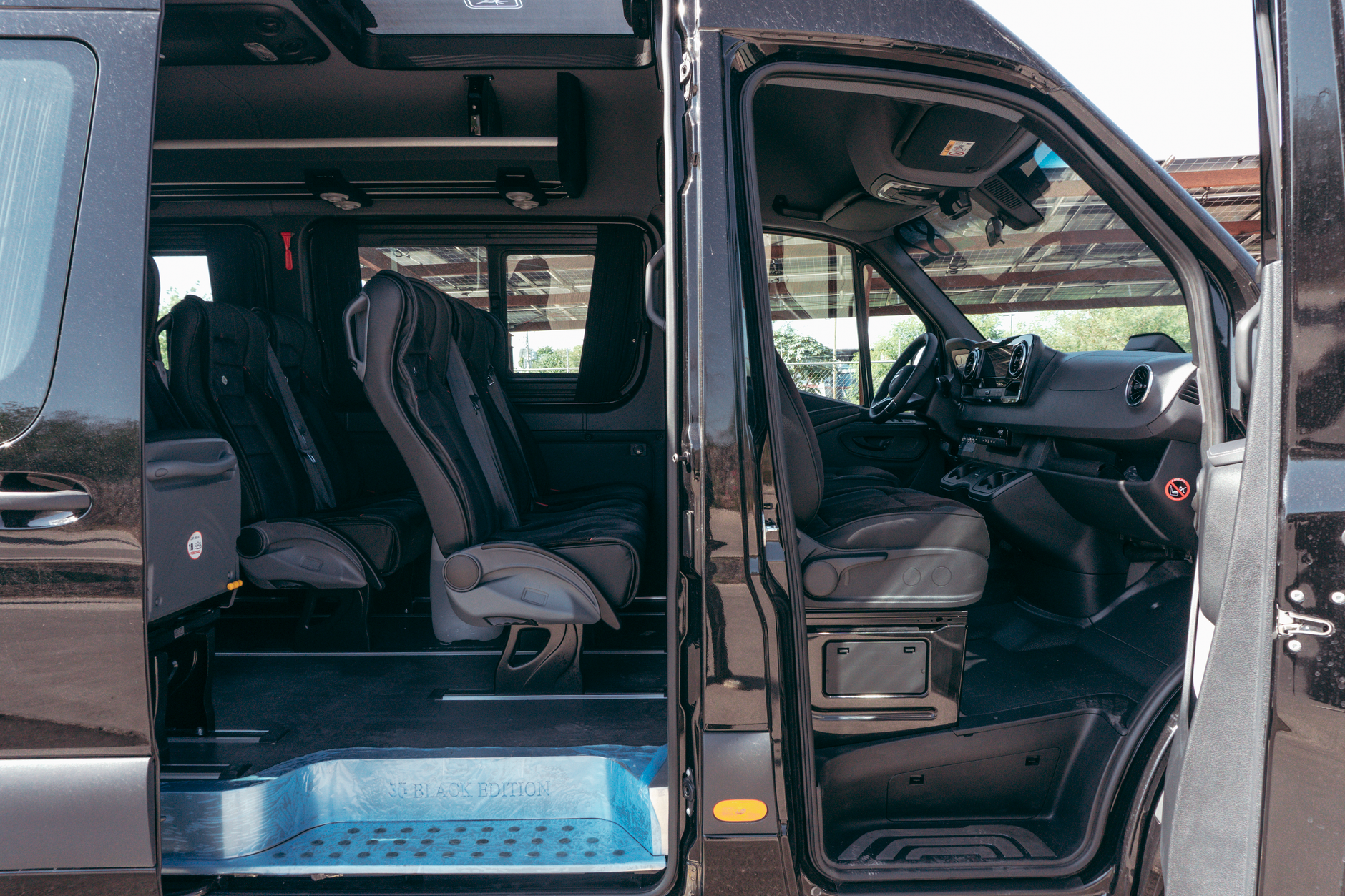
A 14-Passenger Sprinter is usually the right starting point when the group has 14 passengers, limited luggage, and wants one dedicated vehicle for a private group tour. An Executive Mercedes Sprinter or Ford Transit may offer leather captain's chairs, WiFi, USB charging, and a quieter cabin than a conventional shuttle. Small cargo space means passengers should consolidate soft bags and disclose coolers, camera cases, mobility equipment, or outdoor gear before pricing. The vehicle fits most paved Death Valley routing, but tight scenic roads, restricted overlooks, limited parking, heat exposure, and commercial loading rules still require a driver-led plan. If the headcount, baggage, or comfort requirement grows, a motor coach or larger mini coach may be operationally safer than filling every seat.
| Vehicle | Seats | Best For | Notes |
|---|---|---|---|
| Executive Mercedes Sprinter | Up to 14 passengers | Use it for a private Death Valley group tour with light luggage, executive transfers, or a small multi-day party that values cabin comfort over cargo capacity. | Best for VIP groups with leather captain's chairs, WiFi, USB charging, and a small cargo area; confirm the exact interior and luggage layout before booking. |
| Ford Transit passenger van | Up to 14 passengers | Use it when the group needs one compact vehicle for hotel transfers and sightseeing without the executive interior requirement. | A practical alternative for paved park routing and smaller budgets, but comfort, seat spacing, climate control, and luggage capacity vary substantially by conversion and operator. |
| Mini coach | Approximately 18 to thirty passengers | Use it when the group exceeds Sprinter capacity, carries substantial luggage, or needs more seats without moving all the way to a full motor coach. | Adds a higher roof, more usable luggage space, and a more conventional tour layout, but requires more care around narrow roads, turnaround points, and park parking limits. |
| Motor coach | Approximately thirty-five to fifty-six passengers | Use it for a larger organized group traveling on main paved corridors with advance parking and commercial-tour coordination. | Provides the most passenger and luggage capacity but is less flexible on restricted roads, small parking lots, loading zones, and scenic routes such as Artists Drive or Dantes View. |
Routing, Timing, and On-the-Road Realities
Las Vegas is a common origin for a Death Valley group tour, with routing typically using US 95 toward Beatty or NV 160 through Pahrump before entering the park from the east or west. Los Angeles and San Bernardino departures often use I-15, CA 127, and CA 190, but traffic through the Inland Empire and the Las Vegas corridor can make an early pickup worthwhile. A Sprinter leaving after the morning peak may lose the daylight needed for Dante's View, Zabriskie Point, or Badwater Basin, so day one should usually be treated as a travel and orientation day with one or two first stops rather than a full park loop. The driver needs fuel and rest planning before entering remote sections because services are sparse and cellular coverage is inconsistent. Hotel loading at major resorts, convention properties, and airports also needs a specific curb or staging instruction; 'Las Vegas pickup' is not enough for a dispatch sheet.
Inside the park, the run should be sequenced geographically to avoid repeated backtracking from Furnace Creek. A typical south and central day can combine Zabriskie Point, Furnace Creek Visitor Center, Badwater Basin, Devil's Golf Course, and a permitted or suitable segment of Artist's Drive, while a north day can cover Mesquite Flat Sand Dunes and Stovepipe Wells if road and parking conditions allow. Commercial road-based tours should not assume access to every unpaved road, and road-specific restrictions can affect Artists Drive, Dantes View, Emigrant Canyon, and other narrow or length-limited segments. Loading must occur in designated areas or parking spaces, and the Sprinter should not idle or block traffic while passengers gather. Build the itinerary around a legal duty day: passenger-carrier rules generally allow no more than 10 hours of driving after 8 consecutive hours off duty and no more than 15 hours on duty, so a second driver or an extra overnight may be needed for long-origin runs.
What This Typically Costs
A Death Valley group tour in a 14-Passenger Sprinter is normally quoted from the vehicle's daily minimum, mileage, and total service time rather than from fuel alone. In most markets, a multi-day run commonly carries a per-day charter charge, with a higher seasonal range during October through April when desert weather is most workable and demand rises around holidays, spring-break periods, and organized events in Las Vegas, Los Angeles, and Southern California. The quote also accounts for deadhead miles from the vehicle's home market to pickup and back after drop-off, plus any repositioning between Las Vegas, Pahrump, Furnace Creek, and gateway lodging. Driver overnight lodging, parking, park entrance charges, commercial-use requirements, tolls where applicable, and meals or per diem may appear as separate line items. Fuel adjustments can apply when the itinerary includes long desert loops, extended idling restrictions, or substantial mileage beyond the original estimate. Driver gratuity is commonly budgeted separately, and the final range depends on pickup city, trip length, luggage, hotel location, road access, and whether a motor coach or second vehicle is required.
Frequently Asked Questions
What does a 14-Passenger Sprinter fit best for in Death Valley?
A 14-Passenger Sprinter works well for a small private group, alumni tour, family reunion, executive retreat, photography group, or VIP transfer where the travelers want one vehicle and a dedicated driver. An Executive Mercedes Sprinter or Ford Transit may provide leather captain's chairs, WiFi, USB charging, and a small rear cargo area. The vehicle is comfortable for a limited amount of luggage, but it is not a substitute for a full motor coach when every passenger brings large checked bags or bulky equipment. The layout and available amenities vary by operator, so the requested vehicle should be confirmed in writing.
What are the best months for a Death Valley group tour?
The most practical window for a Death Valley group tour is generally late October through April, when daytime conditions are more manageable for long walks and exposed overlooks. November through February can bring the best sightseeing temperatures but also shorter daylight and occasional rain or cold at elevation. March and April often work well for organized multi-day trips, although spring demand can increase around school breaks and holiday weekends. Summer travel is operationally possible, but extreme heat can affect road conditions, walking plans, vehicle cooling, and the safety of passengers outside the vehicle. The park is open year-round, but individual roads, facilities, and services can close because of weather or conditions.
How many days should a Death Valley group tour take?
A realistic four-day group tour might start with pickup in Las Vegas, Los Angeles, or another Southern California market on day one, followed by travel through Pahrump or Beatty and first stops at Dante's View or Zabriskie Point if daylight and road conditions allow. Day two can cover Furnace Creek Visitor Center, Badwater Basin, Devil's Golf Course, and Artist's Drive only if the vehicle and current restrictions make that routing appropriate. Day three can use the north end for Mesquite Flat Sand Dunes, Stovepipe Wells, Mosaic Canyon access, and a return through Beatty, with the driver avoiding unpaved roads that are restricted to commercial road-based tours. Day four is best reserved for a short morning stop, checkout, and the return corridor, rather than promising a full sightseeing day before a long drop-off. The itinerary should remain flexible for heat, flash-flood damage, road closures, daylight, and parking availability.
Does a 14-Passenger Sprinter need permits in Death Valley?
For a 14-passenger commercial group, the National Park Service lists a commercial group entrance category for vehicles carrying 1 to 15 passengers, with the fee assessed per person; the current fee should be checked before confirmation. A road-based commercial tour may also require a Commercial Use Authorization, and the operator must follow the park's commercial-tour conditions. Passenger loading should occur only in designated loading areas or designated parking spaces, followed by immediate movement to an authorized parking location. Idling is restricted in many areas, including loading zones near park facilities, and passenger-carrying buses must shut down when not underway during the applicable cool-season period unless an exception applies. The carrier should handle park documentation, but the group leader should provide the final passenger count and any special event or photography plans.
Can the Sprinter reach every Death Valley overlook?
A 14-Passenger Sprinter is normally below the park's 25-foot length restriction, but the driver still needs to verify the current vehicle dimensions, turning clearance, road notices, and commercial-tour rules before entering narrow scenic roads. Death Valley commercial road-based tours are generally limited to paved park roads except where the park specifically identifies exceptions, and unpaved routes should not be added casually. Artists Drive, Dantes View, and Emigrant Canyon are subject to vehicle-length or road-specific restrictions, so the dispatcher should confirm whether the requested vehicle can use each segment. Large motor coach routing requires more conservative planning, and a standard Sprinter does not automatically have access to every road or overlook. Park conditions can change after flooding, heat damage, construction, or storms, making a same-week road check necessary.
Where should a group stay during a Death Valley trip?
The cleanest lodging plan is usually one base near Furnace Creek for two or three nights, with a gateway overnight in Las Vegas, Pahrump, Beatty, or Stovepipe Wells depending on the pickup corridor and room availability. Furnace Creek minimizes repeated long drives to central attractions, but inventory can be limited and seasonal rates can be high. Beatty and Pahrump can provide more practical staging for groups entering from Nevada, while Las Vegas works well for fly-in groups and pre-tour hotel pickup. The driver needs a separate compliant room or approved lodging arrangement, and the vehicle may require a suitable overnight parking space. Do not assume that a remote park lodging property can accept a large motor coach, trailer, or late-night arrival without advance confirmation.
How do driver hours affect a multi-day Death Valley itinerary?
Passenger-carrier rules generally limit a driver to 10 hours of driving after 8 consecutive hours off duty and prohibit driving after 15 hours on duty following that rest period. The carrier must also track cumulative weekly limits, including 60 hours in seven days or 70 hours in eight days depending on its operating schedule. Those limits include other on-duty work, so a driver cannot safely or legally treat a morning airport transfer and an evening Death Valley run as separate clocks. A multi-day itinerary should use a realistic duty-day plan, scheduled meal and inspection time, and a second driver or split operation when the pickup and sightseeing schedule exceed the available window. A long Las Vegas to park loop with multiple overlooks can consume the day even when the map mileage looks modest.
How to Book
To quote a Death Valley group tour, have the travel dates, pickup address, passenger count, luggage volume, preferred hotel area, and every requested park stop ready. Include whether the group needs an Executive Mercedes Sprinter or Ford Transit, airport or hotel transfers, mobility equipment space, photography gear, or a motor coach alternative. US Bus Trips can typically return an initial charter range within 4 business hours, subject to carrier availability and a complete routing review. The confirmation should identify the vehicle class, passenger capacity, pickup and drop-off points, driver plan, mileage assumptions, lodging responsibilities, park or venue requirements, cancellation terms, and included line items; contact the booking team with the itinerary rather than relying on a city name alone.
Related Trips You Might Also Consider
- Family Reunion — South Central Region
- Honolulu, HI to North Shore, HI
- Long Beach, CA to Las Vegas, NV
- Yellowstone — 36-Passenger Mini Coach
- Wisconsin Dells — 14-Passenger Sprinter
- Aurora, CO to Colorado Springs, CO
- Cross-Country Charter Bus Overview
- All Group Trip Types
- See the Full Fleet (Sprinters through 56-pax coaches)
- Get a Free Quote in 60 Seconds