
FIRST Robotics teams book group travel for regional events, district competitions, and the FIRST Championship, often moving students, mentors, tools, uniforms, and a competition robot together.
Overview
FIRST Robotics teams in the Southeast commonly book a charter bus for one-day regional competitions, multi-day district events, and longer championship travel. A typical group includes 15 to 45 students, mentors, teachers, chaperones, and sometimes parents or sponsors, but a large school program can require two or more coaches. The trip may begin at a high school in Raleigh, Durham, Greensboro, Charlotte, Columbia, Greenville, Atlanta, Birmingham, Nashville, Louisville, Jacksonville, Tampa, or Orlando. Teams often need a hotel shuttle in addition to the interstate transfer because pit work, inspections, practice, and awards create long days at the venue. A motor coach keeps the group together, gives students a predictable place to rest, and places tools, uniforms, bins, and luggage in underfloor bays instead of passenger seats.
Southeast Robotics Competition travel follows the region's major road network. I-85 is the primary spine for Raleigh, Durham, Greensboro, Charlotte, Greenville, Spartanburg, Columbia, and Atlanta, while I-95 serves eastern North Carolina, Fayetteville, Florence, Charleston-area access, Savannah, Jacksonville, and Orlando. I-75 connects Atlanta with Chattanooga, Knoxville-area routes, Birmingham connections, and Florida, and I-24 or I-40 commonly extends trips toward Nashville and Louisville. A team from Charlotte may travel south to Atlanta, east toward Raleigh or Wilmington, or southwest toward Birmingham; an Orlando team may need a long coach run through Jacksonville and Savannah. These corridors demand early pickup planning because Atlanta, Charlotte, Jacksonville, Orlando, Columbia, and Nashville can lose substantial time during weekday peaks, event release periods, and college-football weekends.
Event calendars shape demand more than ordinary school travel. Regional competitions generally cluster during late winter and spring, with championship travel often concentrated in April; teams should verify the current FIRST schedule and venue instructions before locking dates. North Carolina events may use large convention or campus venues around Raleigh, Greensboro, Charlotte, or Durham, while South Carolina activity often centers on Columbia, Greenville, or Charleston-area facilities. Georgia and Florida teams may stage at the Georgia World Congress Center in Atlanta, the Orange County Convention Center in Orlando, or large school and university venues, with Alabama, Tennessee, and Kentucky routes frequently connecting through Birmingham, Nashville, Knoxville, Chattanooga, or Louisville. Spring breaks, beach-season travel, and heavy college-football volume can reduce coach availability and make hotel and parking reservations harder. The safest plan books the charter bus after the competition date is confirmed but before the Southeast spring and sports calendars tighten supply.
Fleet Options
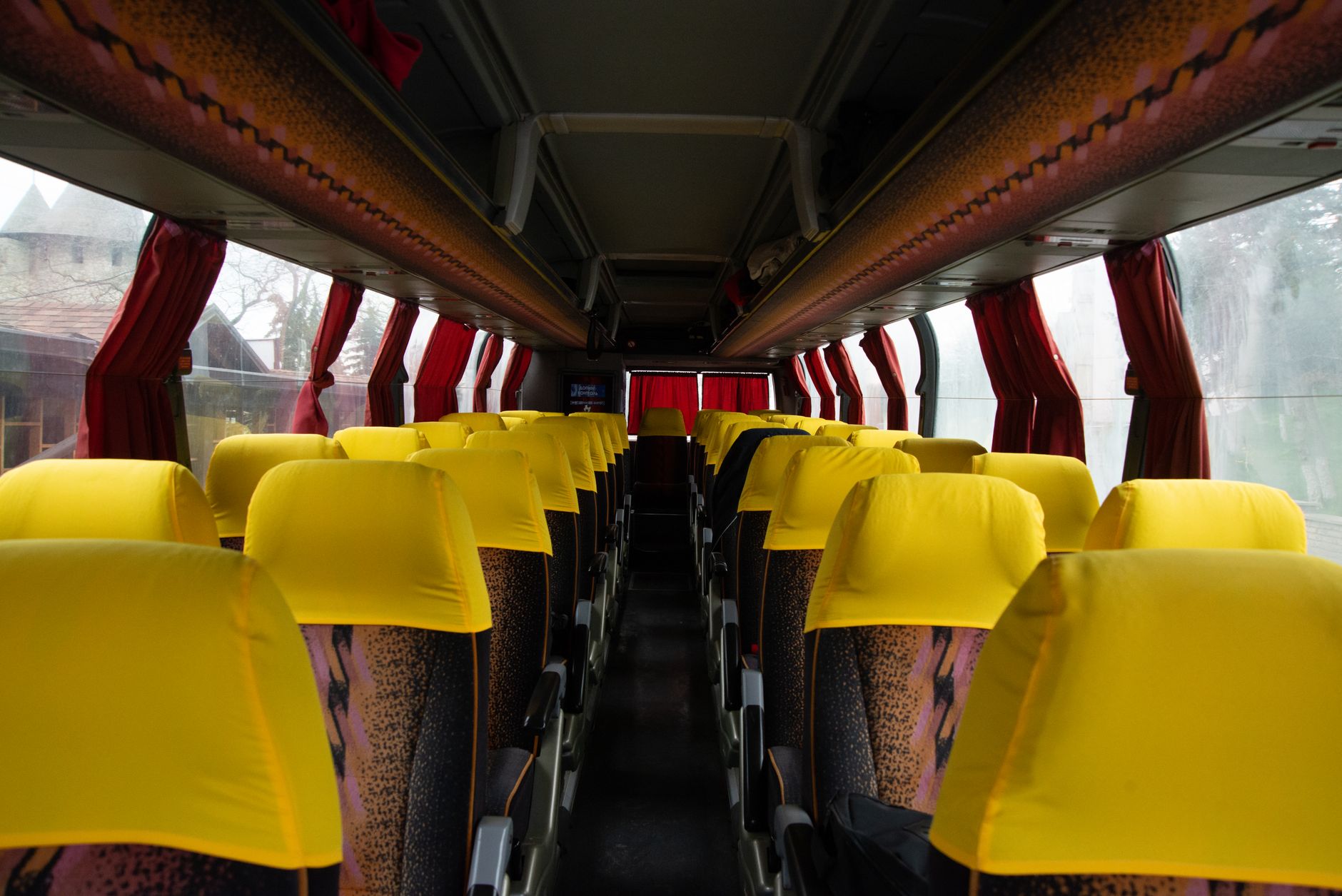
Vehicle selection starts with the passenger count, but cargo volume and route length often control the final decision. A full-size motor coach gives the best combination of reclining seats, climate control, restrooms on many models, and underfloor storage for long Southeast group travel. Smaller teams may fit a mini coach or executive Sprinter, though equipment can consume seats and storage quickly. Tight downtown streets, convention-center curb rules, hotel driveways, and limited bus parking in beach markets can favor a smaller vehicle or a staged drop-off. Large teams should keep people, luggage, and robot equipment in separate loading plans whenever possible.
| Vehicle | Seats | Best For | Notes |
|---|---|---|---|
| Full-size motor coach | 40-56 passengers | Use for a complete school team traveling from markets such as Charlotte, Raleigh, Atlanta, Nashville, or Orlando to a regional or championship event. | Best for interstate comfort and underfloor bays; confirm crate dimensions, restroom availability, height clearance, and venue bus staging. |
| Mini coach | 24-38 passengers | Use when the group is below full-coach capacity and the cargo inventory fits in the rear or underbody compartments. | Works well for smaller teams and shorter regional runs, but storage is limited and large robot cases may reduce usable seating. |
| Mini bus | 18-32 passengers | Use for airport transfers, practice-site shuttles, or overflow service around a competition city. | Useful for local shuttles and venue-hotel movements; it may lack a restroom and has less room for stacked equipment than a motor coach. |
| Executive Sprinter | 8-14 passengers | Use for mentors, judges, staff, or a small scouting group traveling separately from the main team. | Easy to route through downtown streets and hotel entrances, but luggage and equipment capacity are tight and multiple vans require coordinated dispatch. |
Routing, Timing, and On-the-Road Realities
Route planning should work backward from inspection, pit setup, and opening ceremonies rather than from the event start time alone. For I-85, schedule margin through Charlotte, Greensboro, Greenville, Spartanburg, Columbia, and Atlanta, especially when a Friday arrival overlaps commuter traffic. I-95 adds coastal freight traffic, bridge and interchange delays, and seasonal congestion near Jacksonville and Orlando, while I-75 can slow around Atlanta, Chattanooga, and Florida holiday traffic. A morning pickup before the local peak is often preferable to a later departure that looks shorter on paper but reaches the venue during the load-in rush. The itinerary should include planned fuel and driver breaks, a meal stop that can accommodate a motor coach, and a backup arrival window for equipment unloading. Venue parking may require a remote coach lot, timed curb access, or a driver drop-and-relocate procedure, so the bus cannot be assumed to wait outside the doors.
For multi-day group travel, dispatch must account for federal driver-hours rules, required rest, hotel parking, and the difference between passenger service and equipment handling. A long run from Charlotte to Atlanta, Raleigh to Orlando, or Nashville to Orlando may require an overnight stop or a relief-driver arrangement rather than an aggressive same-day schedule. Drivers should receive the venue entrance, bus staging address, hotel coach parking instructions, and a contact for the team lead before departure. Convention centers in downtown Atlanta, Charlotte, Raleigh, and Orlando can have low-clearance approaches, one-way streets, active loading docks, and strict curb limits. College campuses and beach destinations add pedestrian traffic, game-day closures, narrow access roads, and limited turning space. For a large team, use a lead vehicle or designated coordinator, load by labeled equipment category, and set one passenger pickup point so multiple coaches do not block the same curb.
What This Typically Costs
Pricing for a Robotics Competition trip is usually built from vehicle days, route miles, and the time the coach must remain available. Southeast operators commonly apply a one or two day minimum for regional events, while championship runs can involve several operating days plus a long repositioning leg. The quote may include deadhead miles from the bus base, tolls, parking, fuel adjustments, and driver overnight lodging when the route extends beyond a same-day return. Peak pricing commonly appears during spring regional season, April championship travel, college-football weekends, and beach-season demand in Florida and the Carolinas. Driver gratuity is typically listed separately or treated as an optional customary line item. In most markets, a full-size motor coach commonly runs a few thousand dollars per day, while smaller vehicles price lower but may require multiple units for people and equipment.
Frequently Asked Questions
Can a charter bus carry a competition robot and team luggage?
Yes, but the vehicle must be assigned and loaded with the cargo plan in mind. A standard motor coach has underfloor bays suitable for totes, tool cases, bins, luggage, and boxed parts, but tall or irregular robot crates need measurements before dispatch. Teams should separate fragile electronics, batteries, and tools from ordinary luggage and identify anything that cannot be stacked. If the robot requires a liftgate, unusually wide crate, or trailer, that should be disclosed before quoting because a passenger coach may not be the correct equipment.
How large is a typical Robotics Competition travel group?
Most school-based teams travel with roughly 15 to 45 people, including students, mentors, teachers, and chaperones. Larger alliance organizations or combined school programs may need 50 to 100 or more travelers and several vehicles. The actual bus count depends on whether equipment travels in the same coach, on a second coach, or in a support van. A passenger manifest and cargo inventory are more useful than a headcount alone when selecting vehicles.
Which Southeast corridors are common for regional events?
Common Southeast routing follows I-85 between Charlotte, Greensboro, Durham, Raleigh, Greenville, Columbia, and Atlanta, with I-95 serving Richmond, Fayetteville, Florence, Charleston-area access, Savannah, Jacksonville, and Orlando. I-75 connects Atlanta, Chattanooga, Knoxville-area approaches, Birmingham connections, and Florida markets, while I-40 and I-24 often complete routes toward Nashville. Teams may also travel from Charlotte or Raleigh to Atlanta, from Atlanta to Orlando, or from North Carolina and South Carolina to championship flights or long-distance bus departures. The route should be planned around venue load-in windows rather than only the fastest highway estimate.
Should a team book a charter bus or a motor coach?
A motor coach is usually the best fit when the team needs one vehicle for a longer intercity run and has enough passengers to use the underfloor bays. A mini coach can work for a smaller team with limited cargo and a shorter route. An executive Sprinter is useful for mentors, judges, or a small scouting group but rarely replaces the main team bus when equipment is involved. If cargo is bulky, a second passenger vehicle, cargo van, or dedicated trailer may be more practical than overloading the coach.
Can the bus wait at the competition venue all day?
Yes, but the bus needs a confirmed staging plan and a legal place to wait. Convention centers such as the Raleigh Convention Center, Charlotte Convention Center, Georgia World Congress Center in Atlanta, and Orange County Convention Center in Orlando may direct buses to specific curb zones, remote lots, or timed loading areas. The driver may need to drop the team, move the vehicle, and return at a scheduled pickup rather than remain at the entrance. Venue rules can change for event week, so the operations team should verify coach access, parking, height limits, and load-in instructions before dispatch.
How do we arrange accessible transportation for team members?
A wheelchair-accessible motor coach can be requested, but availability is more limited than for standard coaches and should be reserved early. Provide the number of wheelchair users, chair dimensions, whether riders remain seated in their chairs, and the amount of mobility equipment. Lift operation adds loading time, so pickup and venue staging should include a practical boarding window. The hotel, venue, and bus parking plan should also be checked for accessible paths and curb conditions.
What information is needed to book a Robotics Competition trip?
Start with the exact dates, pickup address, passenger count, equipment dimensions, destination venue, hotel, practice stops, and expected return time. Include whether the team needs early-morning departures, multiple daily shuttles, a separate mentor vehicle, or overnight storage for equipment. For Southeast routes, provide the preferred corridor and any fixed load-in or inspection appointment because traffic can materially change the schedule around Atlanta, Charlotte, Orlando, and beach destinations. US Bus Trips can usually return an initial quote within 4 business hours, then issue confirmation with vehicle type, driver contact process, pickup details, itinerary, payment terms, and cancellation conditions.
How to Book
To start a booking, have the dates, pickup address, headcount, equipment list, robot or crate dimensions, destination venue, hotel, practice stops, and return schedule ready. Note any wheelchair users, early load-in appointments, separate mentor travel, or need for multiple vehicles. US Bus Trips can typically provide an initial quote within 4 business hours, subject to route, vehicle, and date availability. Confirmation includes the assigned vehicle category, itinerary, pickup instructions, operating contacts, and applicable payment and cancellation terms; contact US Bus Trips with the trip details for dispatch review.
Related Trips You Might Also Consider
- Acadia — 36-Passenger Mini Coach
- Yellowstone — 24-Passenger Mini Bus
- Wichita, KS to Oklahoma City, OK
- Minneapolis, MN to Fargo, ND
- Senior Tour Group — Mid-Atlantic Region
- Hershey — 24-Passenger Mini Bus
- Cross-Country Charter Bus Overview
- All Group Tour Destinations
- See the Full Fleet (Sprinters through 56-pax coaches)
- Get a Free Quote in 60 Seconds