
US Bus Trips arranges charter bus and motor coach service for Boy Scout, Girl Scout, and Cub Scout trips across Washington, Oregon, and Alaska.
Overview
Pacific Northwest Scout Troop travel usually combines transportation with an outdoor program rather than a simple point-to-point transfer. Groups leave Seattle, Tacoma, Everett, Bellingham, Portland, Salem, Eugene, Spokane, or Boise-area meeting points for campgrounds, council properties, state parks, waterfront sites, and mountain trailheads. Common destinations include Mount Rainier and Olympic National Park areas in Washington, the Oregon Coast and Cascade foothills, and regional event grounds used for camporees or jamborees. A typical order includes one outbound movement, several local shuttles, and a return trip after gear is repacked. Leaders often need the vehicle available for meal runs, emergency repositioning, or staged pickups, so the itinerary should show all operating periods rather than only the main drive.
A Pacific Northwest group travel plan may run along I-5 from Seattle through Tacoma and Olympia to Portland, Salem, and Eugene, then branch toward the coast, the Cascades, or southern Oregon. Scout Troop customers range from a single den or patrol with several adults to council-level events moving multiple units in waves. Passenger counts commonly range from fewer than 20 to 50 or more per vehicle, while large jamborees may require a coordinated fleet of charter buses. Cargo planning matters because tents, sleeping bags, duffels, flags, uniforms, coolers, instruments, and program equipment compete for storage. Wheelchairs, mobility devices, medical supplies, and service animals must be identified when requesting an accessible charter bus rather than added after dispatch.
Washington ferry crossings create a separate planning layer for island programs, marine camps, and Olympic Peninsula itineraries. Routes involving Port Townsend and Coupeville or Anacortes and the San Juan Islands can use vehicle reservations, while other Washington State Ferries routes generally operate without vehicle reservations and require terminal coordination. The coach still needs passenger and vehicle fare planning, and the ferry operator requires appropriate group documentation for school-style travel. In Alaska, Anchorage, Juneau, Seward, and Whittier may appear in cruise-linked group travel, including transfers to or from Seattle sailings and shore-excursion coach work. Those movements are governed by pier access and all-aboard deadlines, not by the flexible timing of a normal camp shuttle.
Fleet Options
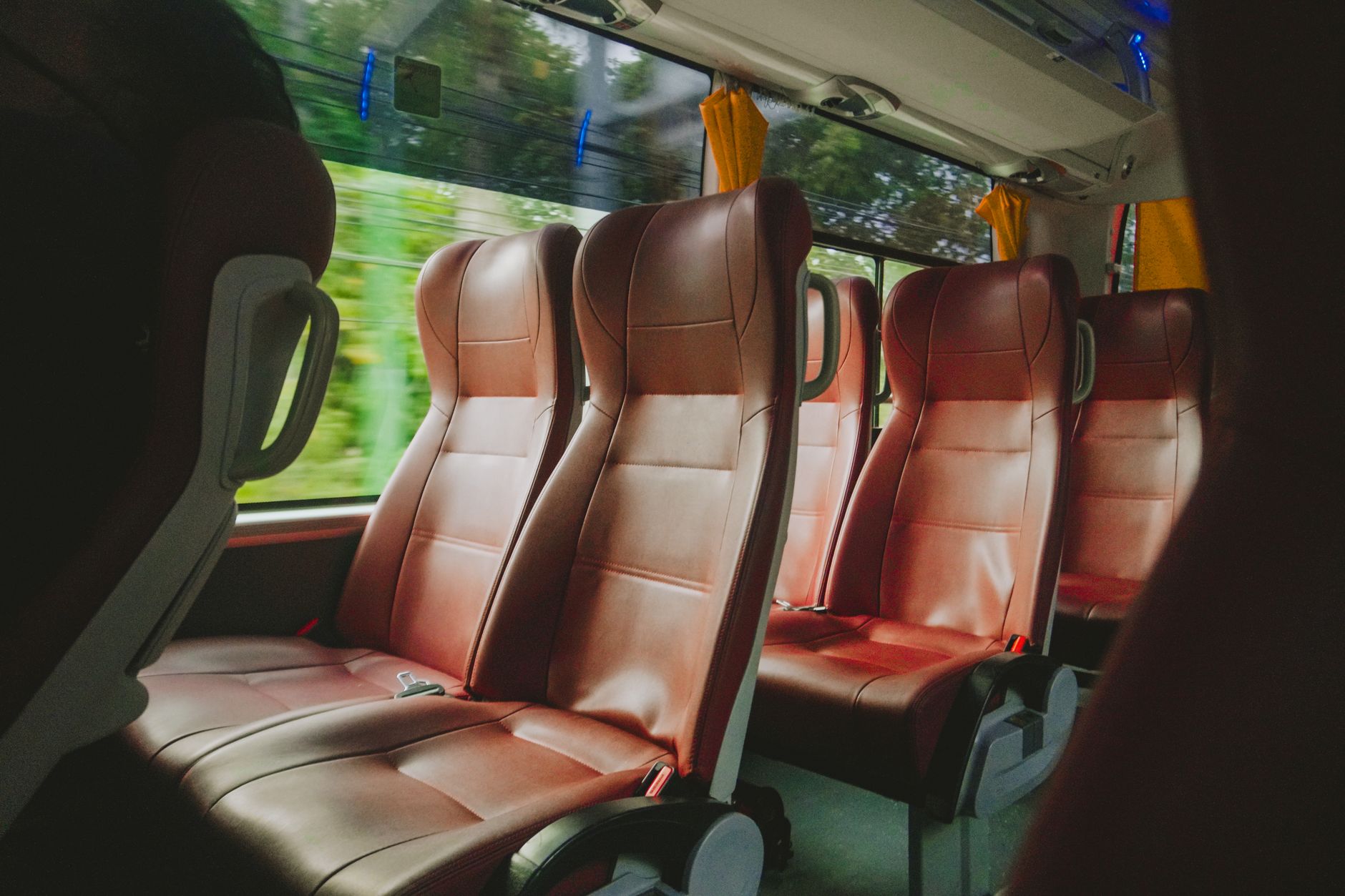
Choose the vehicle from the passenger count and the gear plan together, not from seats alone. A full-size motor coach suits long Pacific Northwest group travel when passengers need luggage bays, climate control, and a restroom, while a mini coach or mini bus can reach smaller camps and tighter urban pickup points. Executive Sprinters work for leaders, small patrols, or short transfers but can fill quickly with camping gear. Confirm wheelchair access, instrument or flag storage, ferry vehicle dimensions, campground turnarounds, and overnight parking before finalizing the fleet.
| Vehicle | Seats | Best For | Notes |
|---|---|---|---|
| Full-size charter bus | 40-56 passengers | Use for a full Scout Troop, multi-city I-5 run, long mountain transfer, or primary vehicle in a jamboree fleet. | Best comfort and underfloor storage for duffels, tents, uniforms, instruments, and longer highway legs; verify camp-road clearance and ferry dimensions. |
| Mini coach | 24-38 passengers | Use for a medium troop, overflow vehicle, leader group, or route where a full-size bus may be difficult to turn or stage. | Provides coach-style seating and useful luggage space with a smaller footprint for campground approaches, coastal roads, and city parking. |
| Mini bus | 18-28 passengers | Use for camporee circulation, hotel-to-venue shuttles, ferry-terminal transfers, or smaller groups on local legs. | Practical for short shuttles and compact pickup zones, but cargo space is limited and bulky camping gear may require a support vehicle. |
| Executive Sprinter | 8-14 passengers | Use for a small Scout Troop, staff movement, airport or cruise-terminal transfer, or a support run between nearby sites. | Comfortable for small patrols or leaders, but luggage capacity drops quickly with camping equipment and accessibility must be confirmed vehicle by vehicle. |
Routing, Timing, and On-the-Road Realities
The I-5 corridor is the regional operating spine, but departure timing changes substantially by metro. Seattle and Tacoma pickups should avoid the morning peak when the group has a fixed ferry, cruise, or venue arrival, while Portland traffic around I-5, I-205, and the Columbia River can affect northbound and southbound plans. A coach leaving Seattle for Portland, or Portland for the Oregon Coast, needs a rest, fuel, and meal plan that does not rely on a highway shoulder or a venue with no bus staging. For mountain routes, the dispatch plan should include elevation, weather, chain requirements where applicable, and a final approach suitable for the selected vehicle. Campgrounds often have narrow gates, unpaved lots, low branches, or no marked bus parking, so a scout leader should confirm the exact unloading point with the site.
Ferry and cruise movements require hard time buffers. Washington State Ferries advises early arrival for reserved vehicle sailings, with roughly 30 to 45 minutes for Port Townsend to Coupeville and 45 to 60 minutes for Anacortes to the San Juan Islands; each vehicle reservation is one-way and does not replace the ticket. For a multiple-coach Scout Troop, dispatch should allow for separate loading lanes, manifests, and the possibility that vehicles are processed in sequence. Alaska cruise-ship shore excursions need a return buffer before all-aboard, plus a pier meeting point that works for every coach. Driver-hours planning should account for deadhead, loading, ferry wait time, meal stops, and overnight repositioning rather than counting only passenger miles.
What This Typically Costs
Scout transportation pricing is usually built around a daily minimum, then adjusted for mileage, route length, vehicle size, and the number of service days. A local camporee shuttle may price by operating day, while a Seattle to Portland or Seattle to Alaska cruise-terminal movement commonly reflects multiple service days, deadhead miles, and driver overnight lodging. Summer weekends, holiday periods, cruise schedules, and major jamborees can create seasonal peaks and tighter fleet availability. Quotes may include fuel adjustments, tolls, ferry charges, parking, driver lodging, and extra staging or standby time. Driver gratuity is normally listed separately or handled according to the group's policy. In most markets, a multi-day charter bus or motor coach assignment commonly runs a few thousand dollars per day, with the final range depending on mileage, equipment, timing, and vehicle count.
Frequently Asked Questions
How many passengers can a Pacific Northwest Scout Troop charter bus carry?
Most Scout Troop trips fall into the 20-to-45-passenger range, although a small patrol or adult-leader group may need only a mini bus or executive Sprinter. Regional camporees and jamborees often move 50 to several hundred participants through multiple vehicles. Headcount should include scouts, leaders, parents, medical staff, and any volunteers riding on each leg. Equipment volume can require a larger vehicle or a separate support van even when passenger numbers are modest.
What vehicles work best for a camporee or jamboree shuttle?
The usual vehicle mix is a full-size charter bus or motor coach for the main passenger load, supported by a mini coach, mini bus, or cargo-capable Sprinter for overflow and equipment. Large jamboree movements may use several coaches in waves, with one dispatcher or trip lead maintaining a manifest and radio or phone contact. Separate gear vehicles can protect aisle space for uniforms, coolers, tents, and accessibility equipment. Matching vehicle types simplifies loading, but mixed fleets can work when pickups involve tight streets or limited parking.
What are common Scout Troop routes in the Pacific Northwest?
The I-5 spine is the most predictable regional pattern, connecting Seattle, Tacoma, Olympia, Portland, Salem, and Eugene. Other common runs reach Bellingham, Spokane, Bend, Medford, the Oregon Coast, Mount Rainier, Olympic National Park, Mount St. Helens, and the Cascade foothills. Scout Troop itineraries often combine a city departure with a coastal or mountain camp, so the final approach may involve narrow roads, steep grades, or limited turnaround space. The dispatcher should verify the camp entrance, bus size limits, road conditions, and unloading point before assigning a full-size motor coach.
How do ferry crossings affect a scout charter bus itinerary?
Ferry work needs to be planned as a scheduled movement rather than an ordinary road stop. Washington State Ferries offer vehicle reservations on the Port Townsend to Coupeville and Anacortes to San Juan Islands routes, while other routes are generally drive-up and still require early terminal staging. Reserved vehicles should arrive roughly 30 to 45 minutes early for Port Townsend to Coupeville and 45 to 60 minutes early for Anacortes to the San Juan Islands. A reservation does not replace passenger or vehicle fare, and each coach may need its own reservation or group notification.
When should a Pacific Northwest Scout Troop book transportation?
Summer is the main peak because camps, hikes, waterfront programs, and school-break travel concentrate between June and August. Late spring and early fall bring camporees, training weekends, and jamborees, while winter trips can involve ski areas, museums, indoor events, and lower-elevation camps. Seattle, Tacoma, Portland, and Eugene usually provide the strongest fleet depth, but remote pickup points may require deadhead planning. Alaska cruise work is tied to the sailing calendar, with Seattle and Vancouver commonly serving as gateways and Anchorage-area ports such as Whittier or Seward supporting land-and-cruise transfers.
Can a charter bus carry scout gear and wheelchairs?
A full-size motor coach generally has underfloor luggage bays, reclining seats, climate control, and a restroom, making it the practical choice for long I-5 or mountain-region days. Confirm the loading plan for tents, duffels, instruments, flags, uniforms, coolers, and mobility devices before selecting capacity. Wheelchair users may need an accessible coach with a lift or ramp, and the request should be made before vehicles are assigned. For Seattle alleys, Portland neighborhood pickups, ferry terminals, or camp roads, a smaller charter bus may have better turning and parking clearance.
How are large scout groups managed across several coaches?
A large group should be divided by vehicle, pickup zone, cabin or campsite, and final destination before arrival day. Each coach needs a manifest, lead adult, emergency contacts, loading sequence, and a defined meeting point that does not block a ferry terminal, cruise pier, campground entrance, or venue lane. For Alaska cruise-ship shore excursions, the schedule must work backward from the all-aboard time, with pier access, luggage handling, and traffic buffers built into the plan. US Bus Trips can coordinate multi-vehicle group travel when the request includes the full itinerary, headcount by leg, equipment details, and accessibility needs.
How to Book
To request a quote, have the dates, pickup address, headcount by leg, destination, campsite or venue address, equipment list, accessibility needs, and complete itinerary ready. Include ferry routes, cruise-ship sailing times, required arrival windows, overnight locations, and whether the coach will wait or deadhead between activities. US Bus Trips generally returns a realistic quote within 4 business hours, subject to route complexity and fleet availability. Confirmation includes the assigned vehicle type, service schedule, pickup instructions, operating assumptions, and billing line items; call or submit the trip details through US Bus Trips to begin.
Related Trips You Might Also Consider
- Government Agency Shuttle — Southeast Region
- Louisville, KY to Nashville, TN
- Academic Decathlon — Mid-Atlantic Region
- Choir Competition — Midwest Region
- Saint Paul, MN to Milwaukee, WI
- Santa Ana, CA to Los Angeles, CA
- Cross-Country Charter Bus Overview
- All Group Tour Destinations
- See the Full Fleet (Sprinters through 56-pax coaches)
- Get a Free Quote in 60 Seconds