
A Williamsburg group tour works best when the motor coach plan is built around venue entrances, hotel staging, and legal driver hours.
Overview
A Williamsburg group tour usually combines living-history sites, a major theme park, and a regional history corridor rather than one single attraction. A practical core itinerary includes Colonial Williamsburg, Historic Jamestowne, Yorktown Battlefield, and Busch Gardens Williamsburg, with the order driven by operating hours, ticket windows, and hotel location. Groups commonly originate in Washington and Baltimore, Richmond, Hampton Roads, Raleigh, Charlotte, or farther away along I-95 and I-64. A 56-Passenger Motor Coach is well suited to school programs, church groups, alumni travel, military reunions, and escorted tours that need one manifest and one loading plan. The coach should not be treated like a car at the historic area because downtown streets include signed no-through-bus segments and restricted curb use. Dispatch should have the group leader's mobile number, venue contacts, hotel bus instructions, and a passenger count before the first departure.
Day 1 should be treated as a controlled travel day when the group is coming from outside eastern Virginia. From the Northeast, the normal planning corridor is I-95 south toward Richmond, then I-64 east toward Williamsburg, with congestion risk around Baltimore, Washington, Fredericksburg, and Richmond. From the west or south, the motor coach may use I-64, US 60, or Hampton Roads approaches depending on the origin and destination. A first stop can be a scheduled meal or rest break near the corridor, followed by hotel check-in and a short orientation rather than an ambitious park visit. Day 2 can center on Colonial Williamsburg, using the Visitor Center or another approved bus arrival point and a separate long-term staging plan. Day 3 can cover Busch Gardens, while Day 4 can pair Jamestown and Yorktown if the driver schedule and museum hours allow. The itinerary should reserve recovery time for traffic, passenger loading, meal delays, and venue security procedures.
Lodging is easiest when the hotel can accept a full-size motor coach, provide a safe overnight location, and accommodate a group breakfast or early departure. Hotels along the Williamsburg commercial corridors, Route 60, and I-64 access points often simplify bus movements compared with properties on narrow historic-area streets. A group staying near the Visitor Center can reduce local deadhead, but the coach still needs a confirmed overnight parking location rather than an assumption that a curb or fire lane is available. For a Jamestown and Yorktown program, staging near the central Williamsburg area generally keeps the group between the two sites while preserving access to Busch Gardens and Colonial Williamsburg. Multi-day groups should ask whether the hotel has a separate bus entrance, turning clearance, idling rules, and driver room policy. If the coach leaves the hotel each day, dispatch should account for repositioning time even when the mileage looks minimal.
Fleet Options
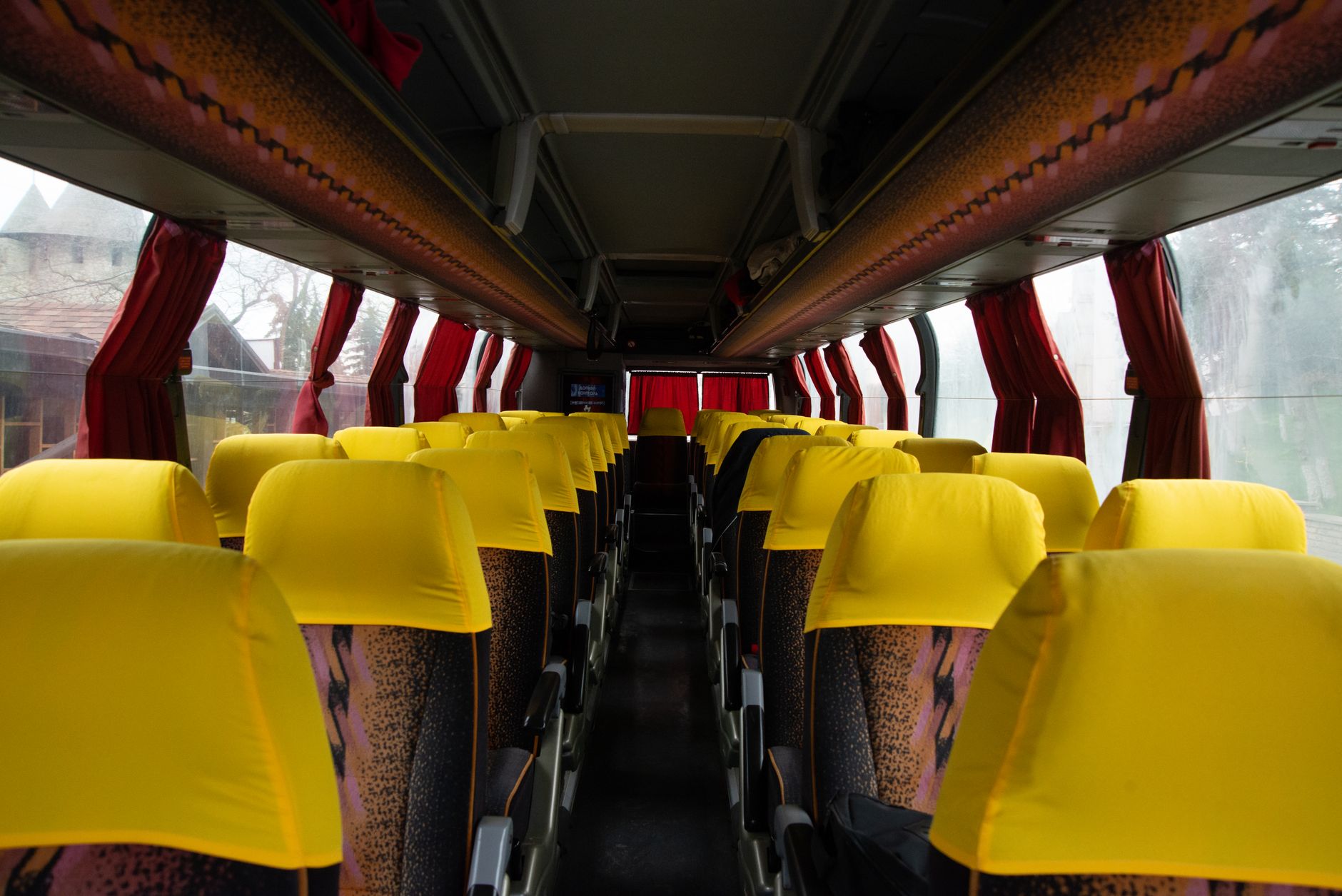
A 56-Passenger Motor Coach is the normal first choice when the headcount is near full capacity and the group has luggage for several nights. It is the workhorse of long-haul group travel, with reclining seats, overhead storage, a restroom, DVD and USB capability, and luggage bays under the cabin. It keeps a school, alumni group, tour operator, or family reunion together instead of dividing people among vans. The tradeoff is physical size: historic-area streets, hotel porte-cocheres, and venue lots require designated bus approaches and may not support casual curbside waiting. For smaller groups or tight local movements, a mini coach or executive Sprinter may be easier to stage.
| Vehicle | Seats | Best For | Notes |
|---|---|---|---|
| 56-Passenger Motor Coach | Up to 56 passengers | Use for a full group tour with multi-day luggage, long interstate travel, and a requirement that everyone ride together. | Best long-haul comfort and luggage capacity, but use designated bus entrances, approved staging areas, and oversize routing around historic streets. |
| 40- to 50-Passenger Motor Coach | 40 to 50 passengers | Use when attendance is below full capacity but the itinerary still includes long corridors, hotel changes, and substantial luggage. | Provides similar reclining-seat comfort and underfloor luggage space with a little more capacity margin for equipment, but still needs motorcoach parking. |
| 24- to 35-Passenger Mini Coach | 24 to 35 passengers | Use for a mid-size group tour that needs more maneuverability than a full motor coach and does not require maximum baggage volume. | Easier at smaller hotel drives and local stops, though storage and onboard amenities vary and full multi-day luggage can become restrictive. |
| Executive Sprinter | 8 to 14 passengers | Use for a small delegation, airport transfer, overflow movement, or tight-street local itinerary rather than the main multi-day group. | Works well for short transfers and small VIP groups, but luggage space is limited and it is not a substitute for a full motor coach on a 56-passenger booking. |
Routing, Timing, and On-the-Road Realities
A 56-Passenger Motor Coach approaching Williamsburg from the north typically runs I-95 through the Washington and Fredericksburg corridor before joining I-64 near Richmond. Morning pickup times should avoid known commuter peaks, and the schedule should include extra time for construction, incident traffic, and rest stops rather than relying on a consumer map's fastest estimate. From Richmond and points west, I-64 is the direct approach, while Hampton Roads traffic can affect the final leg near Newport News, Hampton, and the bridges. Use US 60 or other local roads only after checking coach clearances, turn radii, and venue instructions. Colonial Williamsburg guidance identifies Route 60 as the approach for buses going to the Visitor Center or Group Arrivals Building. A driver should receive the exact hotel entrance, venue gate, bus lot, and passenger meeting point in the dispatch packet.
Venue sequencing matters because a coach can spend more time repositioning than passengers expect. Colonial Williamsburg uses short loading areas and designated long-term bus locations, and city instructions prohibit through-bus movements on portions of Nassau, Newport, and Scotland Streets. Busch Gardens directs buses to the Route 60 bus entrance, while its parking and group-ticket process should be confirmed for the specific operating season. The Colonial Parkway is not a casual shortcut for a commercial motor coach because the National Park Service requires the applicable commercial vehicle permit. Federal passenger-carrier rules generally cap driving at 10 hours after 8 consecutive hours off duty and on-duty time at 15 hours after that rest period. For a multi-day group tour, the driver may need a full hotel overnight, a later start after a long arrival day, or a second driver if the itinerary combines a distant pickup with a full park day and evening return.
What This Typically Costs
A Williamsburg group tour is usually quoted by the day, mileage, and operating plan rather than by passenger count alone. A 56-Passenger Motor Coach commonly carries a daily minimum, with additional charges when the run exceeds the included mileage or requires extra service days. Deadhead miles from the motor coach base to pickup and back can materially affect the quote, especially for groups starting outside Virginia or traveling one way. Peak spring weekends, summer school breaks, fall event dates, and holiday periods commonly price higher because coach availability tightens. The estimate may also include driver lodging, parking, tolls, fuel adjustments, and a second driver if the schedule cannot fit one-driver hours-of-service limits. Driver gratuity is normally a separate line item or customary percentage, and the customer should ask whether it is included. In most markets, a multi-day motor coach booking commonly runs a few thousand dollars per day before long-distance mileage, lodging, and special venue charges are added.
Frequently Asked Questions
What does a 56-Passenger Motor Coach include for a Williamsburg group tour?
A 56-Passenger Motor Coach is the workhorse of long-haul group travel. It has reclining seats, overhead storage, a restroom, DVD and USB capability, and luggage bays underneath. That combination works well when 56 passengers need to travel together for several days with checked bags, backpacks, and park-day gear. It also reduces the coordination problems of splitting a group across smaller vehicles. The coach still needs a planned approach at historic-area streets, hotel drives, and designated bus lots.
How many days should we book for a Williamsburg group tour?
Most groups should plan on three to five days for Williamsburg, depending on the origin and whether the itinerary includes Busch Gardens, Colonial Williamsburg, Jamestown, Yorktown, or all four. Day 1 is often a travel day with a meal stop and a first look at the area rather than a full park day. Two full activity days can cover Colonial Williamsburg and Busch Gardens, while three activity days allow Jamestown and Yorktown without rushing. A group traveling from the Midwest, Northeast, or Southeast may need an additional overnight because the coach must account for legal driving and service time. A multi-day schedule also gives the driver a proper overnight reset.
What are the best months to visit Williamsburg with a group?
Late spring and early fall are usually the easiest operating periods because temperatures are more manageable and the schedule avoids much of the summer heat. Summer works for school and family groups, but weekend traffic, theme-park demand, heat, and hotel compression can increase costs. Fall weekends may be attractive for history programs and seasonal events, yet event dates can sell out hotels and buses well ahead of time. Winter can offer lower demand but shorter daylight, weather risk, and reduced operating schedules at some attractions. Confirm venue calendars before fixing the coach dates.
Where does a motor coach park at Colonial Williamsburg?
Colonial Williamsburg uses designated bus drop-off, loading, and parking areas rather than allowing a coach to wait in the historic streets. The Visitor Center is reached from Route 60, and its bus parking and loading procedures should be confirmed for the visit date. City guidance identifies First Transit, the Visitor Center, and participating motels as motorcoach waiting locations. Drivers must observe no-through-bus restrictions on specified streets, including portions of Nassau, Newport, and Scotland Streets. Loading areas are for short passenger movement, not long-term parking.
Does a bus need a permit for the Colonial Parkway?
A commercial vehicle using the Colonial Parkway through Colonial National Historical Park requires the applicable National Park Service permit. A one-day permit is available through Historic Jamestowne or the Yorktown Battlefield Visitor Center, and annual permits may also be available. The permit requirement should be handled before routing a 56-Passenger Motor Coach through the parkway. At Jamestown, groups should use the designated bus parking area and follow venue instructions for arrival. At Yorktown, the Visitor Center has bus access, but the driver should verify current staging directions before dispatch.
How should a 56-Passenger Motor Coach enter Busch Gardens?
Busch Gardens Williamsburg directs buses to use the Route 60 bus entrance for easier group arrival. Bus parking is generally complimentary with paid group admission, subject to the park's current group procedures. The driver may receive complimentary admission under the park's stated group-ticket conditions, but the driver should carry the required CDL and parking documentation to Guest Relations. A group with a large party, reserved tour, or special event should coordinate in advance because arrival windows and parking instructions can differ. Do not send the coach to the regular automobile entrance unless the park specifically directs it.
How do driver hours affect a multi-day Williamsburg itinerary?
Passenger-carrying drivers generally may drive up to 10 hours after 8 consecutive hours off duty and may not remain on duty beyond 15 hours after that rest period. Weekly on-duty limits also apply, commonly 60 hours in seven days or 70 hours in eight days depending on the carrier's operating schedule. Drive time is only part of the operational calculation because loading, waiting, fueling, inspections, and venue movements can consume the workday. A day that looks short on a map can become illegal when a group adds late departures, dinner transfers, and multiple pickup points. Dispatch should build a relief driver, split day, or overnight into the plan before quoting a hard itinerary.
How to Book
To quote the Williamsburg group tour, have the travel dates, pickup address, passenger count, luggage estimate, hotel locations, and complete venue itinerary ready. Include whether Day 1 is travel only, whether the motor coach must remain with the group, and whether Jamestown, Yorktown, Colonial Williamsburg, or Busch Gardens is included. US Bus Trips can typically return a quote within 4 business hours once those details are complete, subject to carrier availability. The confirmation should identify the coach type, service dates, pickup and drop-off plan, mileage assumptions, driver lodging responsibility, venue notes, and included or excluded line items. Reach US Bus Trips through the booking channel on its website or by phone to review the operating plan with a trip coordinator.
Related Trips You Might Also Consider
- High School Band Tour — South Central Region
- Senior Tour Group — Midwest Region
- Henderson, NV to Phoenix, AZ
- New Orleans Mardi Gras — 24-Passenger Mini Bus
- Alumni Tour — Mid-Atlantic Region
- Dance Competition — Northeast Region
- Cross-Country Charter Bus Overview
- All Group Trip Types
- See the Full Fleet (Sprinters through 56-pax coaches)
- Get a Free Quote in 60 Seconds